
сша · корея · boston dynamics · гуманоиды · промышленность
Boston Dynamics' Atlas in Georgia: what an 'industrial' humanoid actually means
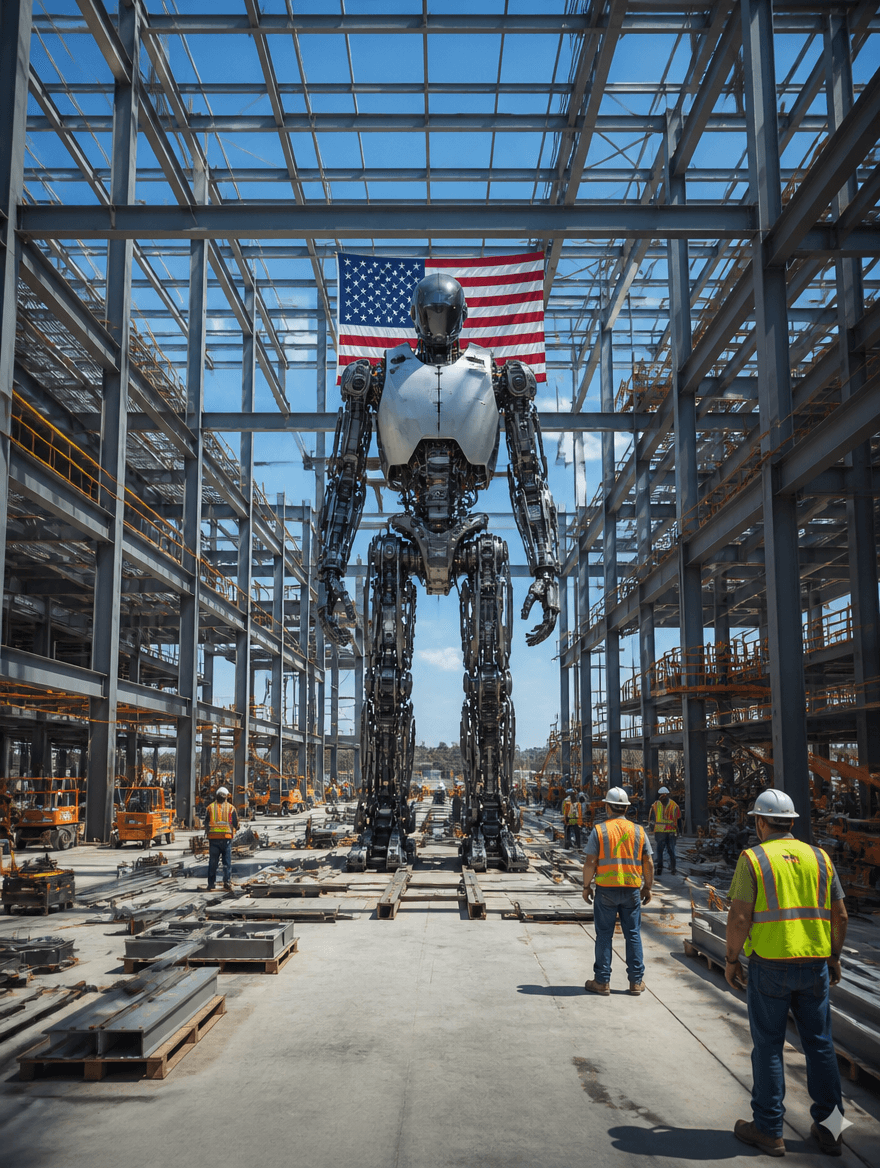
The word "industrial" attached to a humanoid robot has become something of a marketing cliché — nearly every new bipedal robot unveiling comes with staged footage of it supposedly working on a factory floor. But the Boston Dynamics and Hyundai project in the US state of Georgia is a rare case where the word actually carries industrial scale rather than a staged video.
What was shown, and what's being built
Boston Dynamics unveiled the industrial version of its Atlas robot — not the hydraulic, acrobatic machine that spent years jumping around on YouTube demo reels, but a fully electric platform with 56 degrees of freedom, capable of lifting up to 50 kilograms, and able to swap its own battery without human help. That last detail sounds like a minor technical footnote, but it directly determines operating economics: a robot that needs an operator to change its battery every few hours isn't automation — it's semi-automation with an extra headcount attached.
Deployment is planned at a plant in Savannah, Georgia, and is set to begin in 2028. This isn't a pilot line for a dozen units — it's capacity rated at 30,000 humanoids a year, a figure that puts the project in the same league as serious automotive plants by output volume, except robots roll off the line instead of cars.
The money behind the project
The announcement is backed by genuinely large sums. On the Korean side: 125 trillion won in investment (tens of billions of dollars); on the US side, another $26 billion in domestic manufacturing capacity. Google DeepMind and NVIDIA are partners on the project, bringing together three distinct capabilities at once — mechanics and locomotion from Boston Dynamics, heavy industrial manufacturing and capital from Hyundai, and computing/AI infrastructure from DeepMind and NVIDIA.
That is fundamentally different from the typical model among Chinese humanoid startups, where a 50-to-200-person team raises a few hundred million dollars and tries to reach a shippable product within two or three years. This is a large capital-project model instead — closer to building a semiconductor fab or a battery gigafactory: a long horizon, enormous capex, and a bet that the industrial humanoid market will genuinely mature by the time the line comes online in 2028.
What 'industrial' means in practice
The difference between an industrial humanoid and a demo humanoid isn't design — it comes down to three concrete things. First, repeatability: the robot must perform the same operation thousands of times in a row without losing accuracy, not once, dramatically, on a stage. Second, integration into existing factory logistics — exchanging data with manufacturing execution systems rather than operating in isolation. Third, service economics: the ability to swap its own battery, run diagnostics, and work shifts comparable in length to a human worker's, not 20-30 minutes between recharges.
Those are precisely the three points where most humanoids unveiled over the past two years fall short — an impressive walking or grasping demo says nothing about whether a robot can survive an eight-hour shift on a real production line. Atlas's stated 56 degrees of freedom and 50 kg payload are a genuine bid at the industrial rather than the demo niche, but only real-world operation after 2028 will confirm it.
What this means for the market
A factory of this scale in the US shifts the picture not just for the American market but for competitors across Asia. Until now, mass humanoid production was associated almost exclusively with China, where the number of companies runs into the dozens and unit costs keep falling thanks to a dense local component supply chain. The Hyundai/Boston Dynamics project is an attempt to build a comparably scaled production loop in North America, backed by Korean capital and American AI infrastructure.
For the industry as a whole, it's a strong maturity signal: when an automaker the size of Hyundai commits tens of billions of dollars to a plant with a payback horizon well past 2030, it means the industrial humanoid market has moved out of venture-bet territory and into capital industrial project territory.
If you're considering partnerships with robotics manufacturers for your own production line, Aura Robotics' catalog can help you find vetted suppliers in the Asian market today, without waiting for 2028.