
япония · toyota · гуманоиды · автопром · автоматизация
Toyota in Aichi: Japan's auto industry hedges its humanoid bet
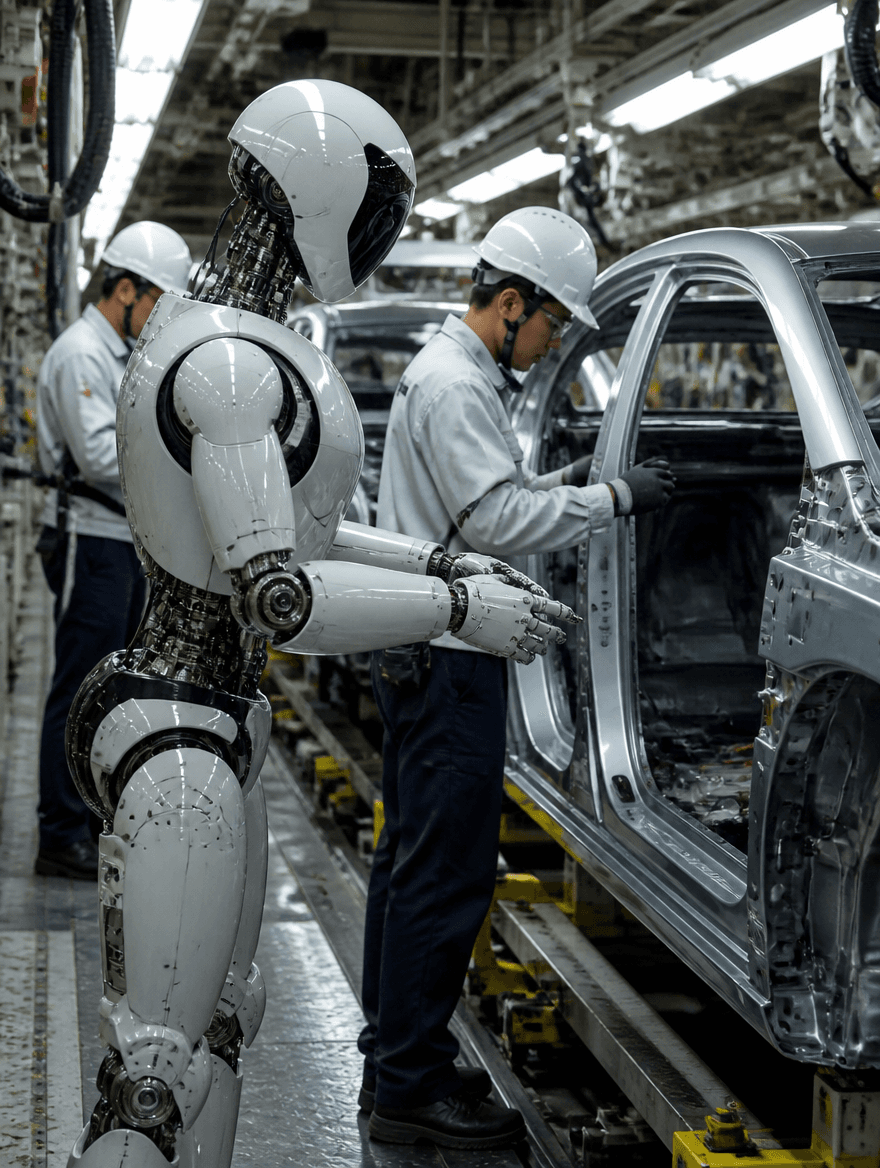
When a large corporation makes two seemingly contradictory bets at once, that's usually not a sign of confusion — it's a sign the market hasn't yet settled on a winning architecture. That is exactly how Toyota's behavior toward humanoid robotics looked in 2026.
Prototypes right on the shop floor
In June 2026, Toyota placed humanoid robot prototypes on a components assembly line at its plant in Aichi prefecture — the company's historical home and still one of its main production hubs. Crucially, this wasn't a trade-show booth or a separate experimental hangar — it was a real assembly line where people work alongside the robots. That's a fundamentally different test than a lab demo: the line doesn't adapt to the robot's pace; the robot has to fit the line's pace.
Aichi isn't a random choice of site for Toyota. It's historically where the company worked out every major manufacturing innovation, from just-in-time production to its most automated assembly sections. Placing humanoids there specifically signals that the company is treating the experiment seriously rather than as an image exercise.
The parallel track: TRI and Boston Dynamics
At the same time, Toyota's research arm, Toyota Research Institute (TRI), released a demonstration video together with Boston Dynamics showing the Atlas robot performing complex manipulation tasks. That's a second, separate track of engagement with humanoid robotics — through partnership with a world-class external developer rather than only internal prototypes.
The two tracks solve different problems. The internal prototypes on the Aichi line are testing the hypothesis of whether a humanoid can actually work at a real assembly line's pace here and now, aimed at Toyota's own mechatronics know-how. The TRI/Boston Dynamics partnership is access to more advanced control and manipulation algorithms that Toyota isn't yet ready, or fast enough, to develop on its own.
Why hedge instead of choosing
The hedging logic makes sense given the broader position of Japan's auto industry. The sector faces an acute labor shortage against an aging population — a theme running through nearly every Japanese automation announcement over the past two years, from airports to factories. And Toyota itself is Japan's largest automaker, meaning the cost of picking the wrong technical architecture is incomparably higher for it than for a startup.
If its own humanoid development bet fails or runs slower than expected, the TRI/Boston Dynamics partnership provides a fallback with access to ready, more mature algorithms. Conversely, if external platforms turn out to adapt poorly to the specifics of automotive assembly — where requirements are very particular: positioning precision, handling heavy and fragile parts at once, and meeting manufacturing quality standards — the internal prototypes on the Aichi line will have built up hands-on practical experience that no partnership agreement can buy.
The broader context of Japan's race
Toyota isn't the only Japanese industrial giant playing on multiple fronts at once. Kawasaki Heavy Industries is developing its own Kaleido platform in parallel, and Mitsubishi Motors signed a memorandum with a University of Tokyo startup for series humanoid production. Meanwhile, Japan as a whole, according to analysts, is losing ground in the global robotics race it essentially invented decades ago: Chinese companies are outpacing Japanese ones both in time-to-market and in investment volume.
In that context, Toyota's strategy looks conservatively rational: rather than try to single-handedly match China's development pace, it's testing several paths at once — in-house engineering and partnership with an industry leader — and betting on whichever technology first proves its economic case on an actual production line, not a demo stage.
What the market will test next
The real test for both of Toyota's tracks won't come at the unveiling stage but at the scaling stage: can the humanoid on the Aichi line hold its pace through a full shift, and how quickly can Atlas's algorithms adapt to the specific demands of automotive assembly if Toyota decides to move the TRI/Boston Dynamics partnership from demonstration into pilot deployment. Answers to those questions will likely not arrive before 2027-2028, but they will determine which of the company's two bets wins out — or whether both turn out to be complementary parts of one broader manufacturing strategy.
For companies looking for automation partners now, rather than after the technology race concludes, Aura Robotics' catalog collects vetted robot manufacturers from Asia.